


Worktop edge profiles are one of the most under-discussed decisions in a kitchen worktop specification, and they shape both how the finished installation looks and how well it holds up over years of use. Most homeowners default to whatever edge the supplier puts in the quote, often without realising the choice is theirs to make and that it genuinely affects daily life with the kitchen. After fabricating thousands of edges across granite, quartz, quartzite, and Dekton installations from our Pudsey workshop, we can give a clear account of what each profile does, where each one suits, and which ones to think twice about.
The industry reality
A worktop edge is the visible front face of the slab where it meets the cabinetry. Edge profiling is the fabrication step that shapes this face into a specific cross-section: square, rounded, angled, or in more complex patterns.
The edge profile affects three things simultaneously. It changes how the worktop looks, particularly in the way light hits the front face. It changes how the worktop feels to touch and lean against. And it changes how durable the worktop is, because some profiles concentrate stress at sharp corners while others distribute it more evenly.
Most worktop quotes default to a standard profile (typically a pencil edge or eased square) and treat anything else as an upgrade. This isn’t dishonest, but it does mean the choice often gets made on price rather than suitability. The points below explain what each profile actually offers and when it’s the right call.
The main edge profiles and what they do
Pencil edge
The pencil edge is the most common default in UK kitchen installations. It’s a square edge with the top and bottom corners gently rounded to a small radius, typically 2 to 3mm.
Visually, the pencil edge reads as clean and contemporary without looking aggressively modern. It works with traditional and contemporary kitchens equally well, which is why it gets specified by default in such a wide range of installations.
Practically, the slight rounding removes the sharpest edge, which makes the worktop more comfortable to lean against and less prone to chipping from impact damage. It’s a sensible compromise between the visual cleanness of a square edge and the durability of a rounded edge.
For most kitchens, the pencil edge is the right answer unless there’s a specific reason to choose something else.
Square edge (or eased square)
The square edge is a true 90-degree corner at the top of the worktop, with no rounding. The “eased” variant breaks the sharp edge with a tiny chamfer, typically 1mm or less, which removes the absolute sharpness without producing a visible curve.
Visually, the square edge reads as the most contemporary and architectural of the standard profiles. It suits minimalist kitchens, contemporary designs with handleless cabinetry, and installations where the worktop is meant to read as a slab rather than a piece of furniture.
The trade-off is durability. The sharper the edge, the more vulnerable it is to chipping from impact damage. Dropped pans, heavy crockery, and the cumulative wear of daily use all concentrate on the leading edge of the worktop, and a true square edge will show damage that a rounded edge wouldn’t.
The square edge is the right call for design-led kitchens where the contemporary look is the priority. It’s the wrong call for households with young children, intensive cooking, or any environment where the worktop will see heavy impact.
Bullnose edge
The bullnose edge is fully rounded, with the front face curving smoothly from the top surface to the bottom edge. The radius can vary from a half-bullnose (rounded on the top half only) to a full bullnose (a continuous curve across the entire front face).
Visually, the bullnose reads as traditional or transitional rather than contemporary. It suits country-style kitchens, Shaker-style cabinetry, and traditional designs where soft edges fit the overall aesthetic.
Practically, the bullnose is the most durable of the standard profiles. There are no corners to chip, the rounded form is gentle to lean against, and impact damage is significantly less likely than on sharper profiles.
The bullnose is the right call for traditional kitchens, households with young children, and any environment where durability matters more than the contemporary aesthetic. It’s the wrong call for kitchens designed around a contemporary, architectural look.
Ogee edge
The ogee edge is a decorative profile with an S-shaped curve combining a convex and concave section. It’s the most ornamental of the common profiles and reads as deliberately traditional.
Visually, the ogee works in classical and period-style kitchens, particularly those with detailed cabinetry, shaker fronts, or designs referencing historic styles. It’s a deliberate design choice rather than a default.
The ogee edge adds cost compared to simpler profiles because the fabrication involves more material removal and more polishing time. It also produces a more delicate edge in places where the profile is thinnest, which can be more vulnerable to chipping than a simpler rounded edge.
For period-style kitchens and high-end traditional designs, the ogee can be the right finishing touch. For most contemporary installations, it looks out of place.
Mitred edge
A mitred edge is created by bonding two pieces of slab at a 45-degree angle to produce the appearance of a thicker worktop. A standard 30mm slab can be mitred to look like 50mm, 80mm, or 100mm depending on the design intent.
Visually, the mitred edge produces a substantial, contemporary look that’s particularly suited to islands, breakfast bars, and feature surfaces where the worktop is meant to read as a major design element. It allows thicker visual proportions without the cost of genuinely thicker slabs.
Practically, the mitred edge requires precision fabrication. The 45-degree joint has to be cut accurately and bonded cleanly to avoid a visible line at the corner. Done well, the joint is almost invisible. Done badly, it shows as a dark line that runs the length of the edge.
The mitred edge is the right choice for design-led contemporary kitchens, particularly on islands or any surface where visual impact matters. It adds significant cost and demands a fabricator capable of delivering the joinery cleanly.
Waterfall edge
A waterfall edge is a related technique where the worktop continues vertically down the side of an island or feature, mitred at the corner so the pattern appears to flow continuously from horizontal to vertical.
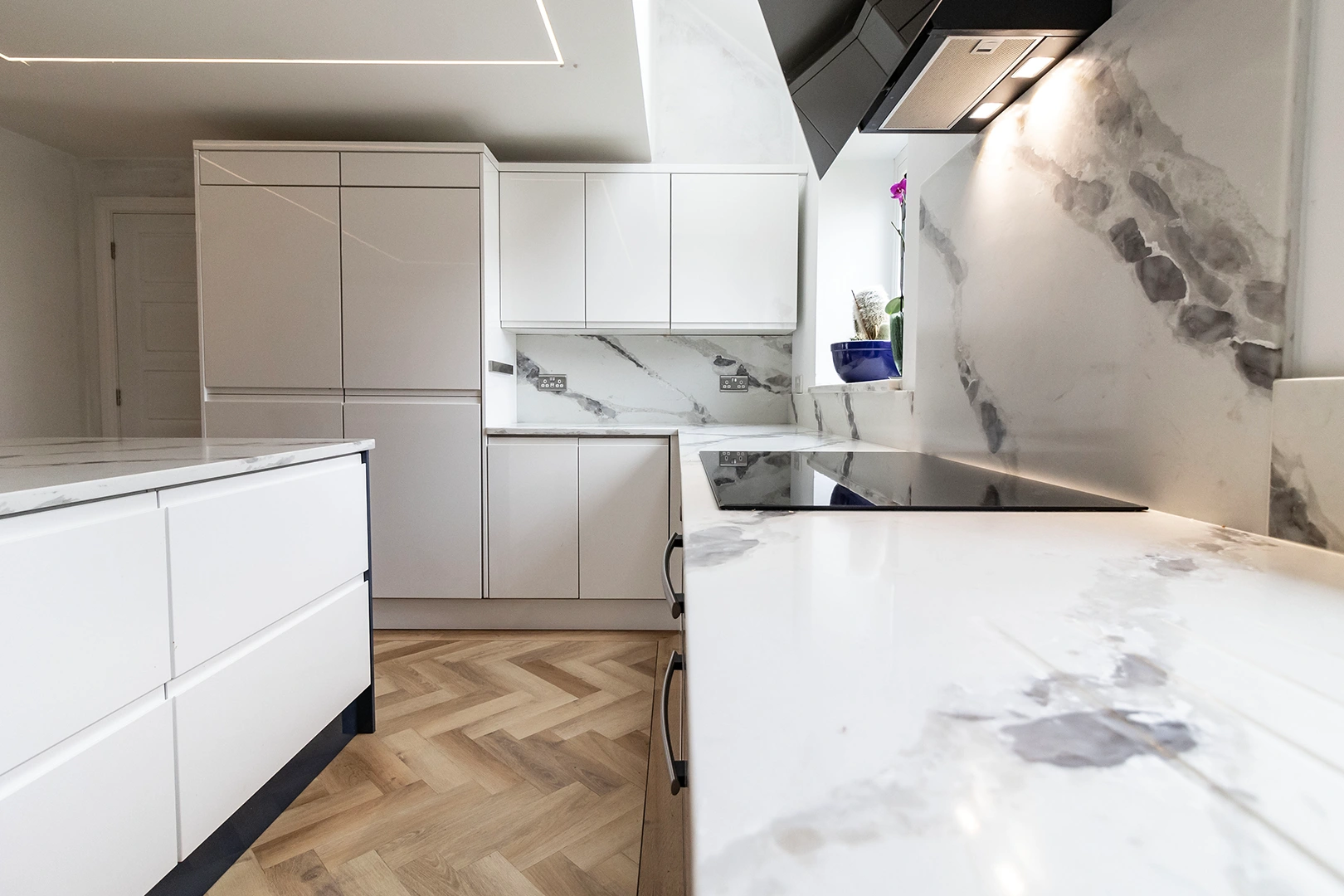
Waterfall edges are popular on contemporary kitchen islands and produce a strong architectural statement when the material is bold (Calacatta-style quartz, dramatic quartzite, or veined granite). They effectively add another slab to the installation, with corresponding cost.
For the waterfall to work visually, the mitre needs to be cut precisely and, on materials with visible pattern, the pattern should be book-matched across the corner. Both require careful planning and a fabricator equipped to handle the work.
Other profiles worth knowing
Several less common profiles are available for specific design situations.
The bevelled edge has a flat angled cut on the top corner, producing a faceted look that suits some contemporary designs.
The double pencil edge has both top and bottom corners rounded to a larger radius than a standard pencil, producing a softer overall appearance suited to traditional kitchens.
The chamfered edge is a flat angled cut taking off the top corner at a defined angle, often used on islands and feature surfaces for a contemporary look without going all the way to a mitre.
These profiles can be excellent in the right context, but they’re specialist choices rather than defaults. We discuss them when a design specifically calls for them rather than offering them as standard options.
How to choose the right edge for your kitchen
The edge profile should follow from the kitchen design, the household’s needs, and the material being used.
For design fit, contemporary kitchens generally suit pencil, eased square, mitred, or waterfall edges. Traditional kitchens generally suit bullnose, double pencil, or ogee. Transitional designs that span the styles work well with pencil edges, which suit either direction.
For household needs, families with young children and households that cook intensively benefit from rounded profiles that resist chipping. Households without these specific pressures have more freedom in their choice.
For material considerations, harder materials (quartzite, Dekton, premium quartz) can sustain sharper edges better than softer materials. Some granites with visible directional grain look better with rounded edges that disguise the grain at the corner.
The honest position is that there’s no universally correct edge. There’s a right edge for the specific kitchen, and a fabricator who discusses the choice properly will arrive at a recommendation that suits the overall design rather than defaulting to whatever’s cheapest to produce.
Real scenarios from installations
A family in Leeds had a contemporary kitchen with handleless cabinetry and a large island. The owners initially wanted a true square edge for the architectural look, but the household included two young children. We talked them through the impact damage risk and recommended a pencil edge that maintains a clean contemporary appearance while reducing the chipping risk. Three years on, the worktop is in excellent condition.
A property in Harrogate had a high-end kitchen designed around a 3-metre island intended as a major design statement. We installed a 30mm Calacatta quartz with a mitred edge built up to 100mm visual thickness, with book-matched veining across the mitre corners. The island reads as a substantial architectural element rather than a worktop sitting on cabinets.
A traditional kitchen in York with shaker cabinetry and a country-style aesthetic called for a softer edge that complemented the overall design. We installed a granite with a full bullnose that suits the cabinetry and reads as period-appropriate. The contemporary square edge that had been quoted by another supplier would have looked out of place.
The questions worth asking before you commit
If you’re choosing an edge profile, the answers to these will help you arrive at the right call:
What’s the overall style of the kitchen, and which profiles suit that style?
Who lives in the household, and does the worktop need to handle heavy impact or intensive use?
What material is the worktop, and which profiles are most suitable for that material specifically?
If a mitred or waterfall edge is being considered, has the fabricator delivered this profile cleanly in past installations?
Is the edge being chosen for visual reasons, durability reasons, or both?
A fabricator who discusses these considerations is one who’ll recommend an edge that works long-term. A fabricator who defaults to whatever’s quickest to produce is one whose finished work will reflect that default.
How Meridian Granite handles edge profile choices
We discuss edge profile as a deliberate design decision rather than a fabrication afterthought. Customers in our Pudsey showroom can see edge samples in person across different materials, which often resolves uncertainty more effectively than discussing options in the abstract.
Fabrication of all standard and specialist edges is carried out in-house using CNC machinery and finished by experienced craftsmen. For mitred and waterfall edges specifically, we plan the cuts and book-matching at templating stage to ensure the finished joints read as intended.
Conclusion
Worktop edge profiles deserve more thought than they typically receive. The choice affects how the kitchen looks, how the worktop feels, and how well it holds up over years of use. Defaulting to whatever’s in the quote produces acceptable results most of the time, but choosing deliberately produces installations that suit the specific kitchen far better.
For most kitchens, the pencil edge remains a sensible default. For design-led installations, mitred and waterfall edges produce stronger results when fabricated properly. For traditional kitchens, bullnose and ogee profiles often suit better than the contemporary alternatives.
If you’d like to see edge samples in person and discuss what suits your kitchen, our Pudsey showroom is open and our team is happy to walk through the choice in detail.