


Calacatta quartz has become one of the most requested worktop materials in UK kitchens, and the conversations we have with customers about it tend to fall into two camps. The first camp has seen Calacatta everywhere on Instagram and Pinterest and assumes all Calacatta quartz is essentially the same. The second camp has read enough to be suspicious of the name and wants to know why one Calacatta-style slab costs significantly more than another that looks similar. Both camps deserve a straight answer, and after years of supplying and fitting Calacatta quartz across kitchens in Yorkshire and the wider UK from our Pudsey workshop, we can give one.
The industry reality
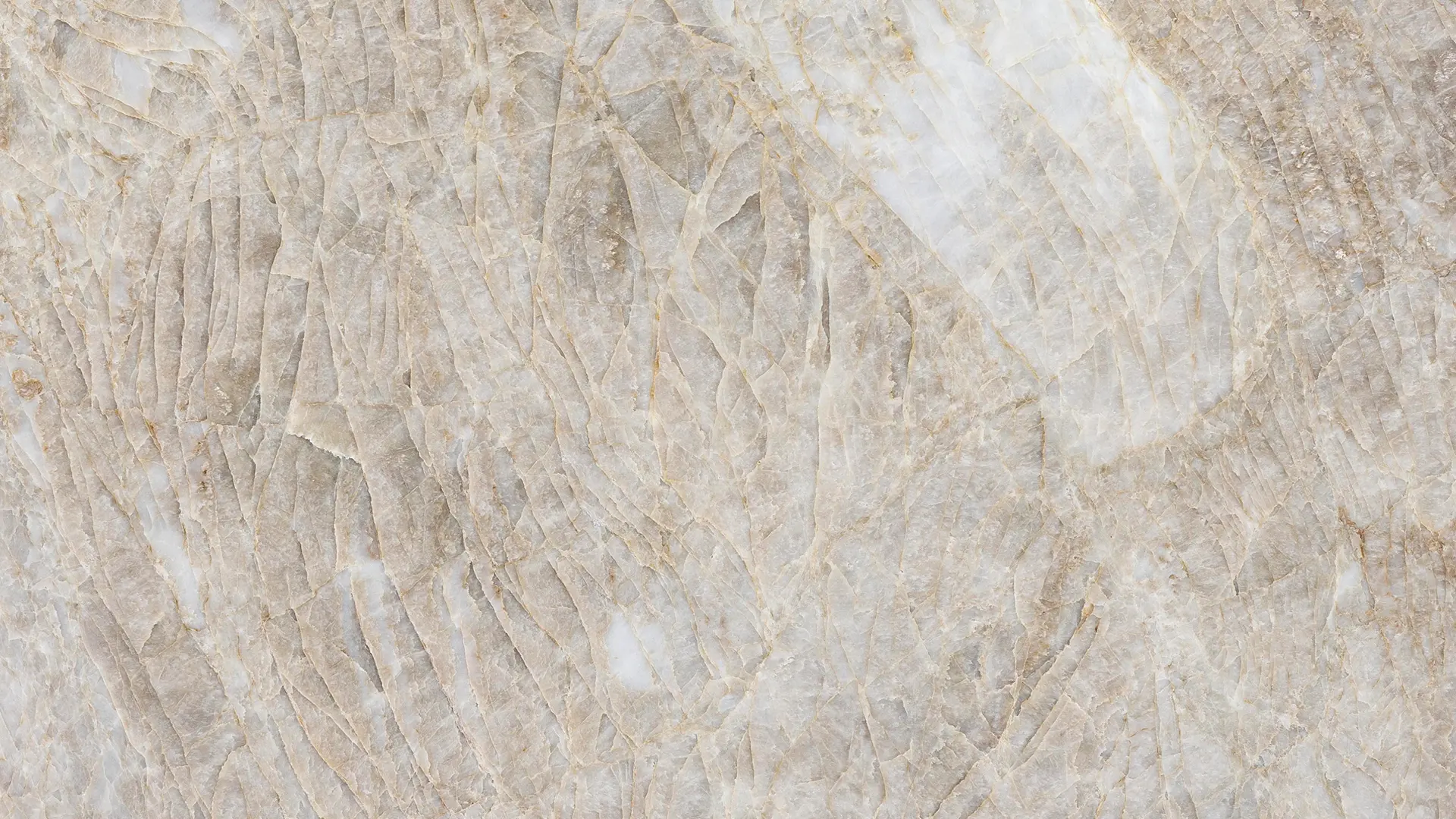
Calacatta is originally the name of a marble quarried in the Apuan Alps of Tuscany. Authentic Calacatta marble is rare, expensive, and visually distinctive: a bright white base with dramatic veining in shades of grey, gold, or warm brown, depending on the specific quarry source.
What gets sold as “Calacatta quartz” is engineered quartz designed to mimic this look. The marble itself is hard to live with in a kitchen (porous, prone to etching from acids, sensitive to stains), so quartz versions have become the practical alternative for homeowners who want the visual impact without the maintenance.
The term “Calacatta” applied to quartz isn’t trademarked or quality-controlled. Any quartz manufacturer can produce a slab with a white base and grey veining and call it Calacatta. The result is that the market includes Calacatta-style quartz at radically different quality levels, all sold under similar names. The points below explain what actually separates them.
What actually makes Calacatta quartz different from standard quartz
The depth and realism of the veining
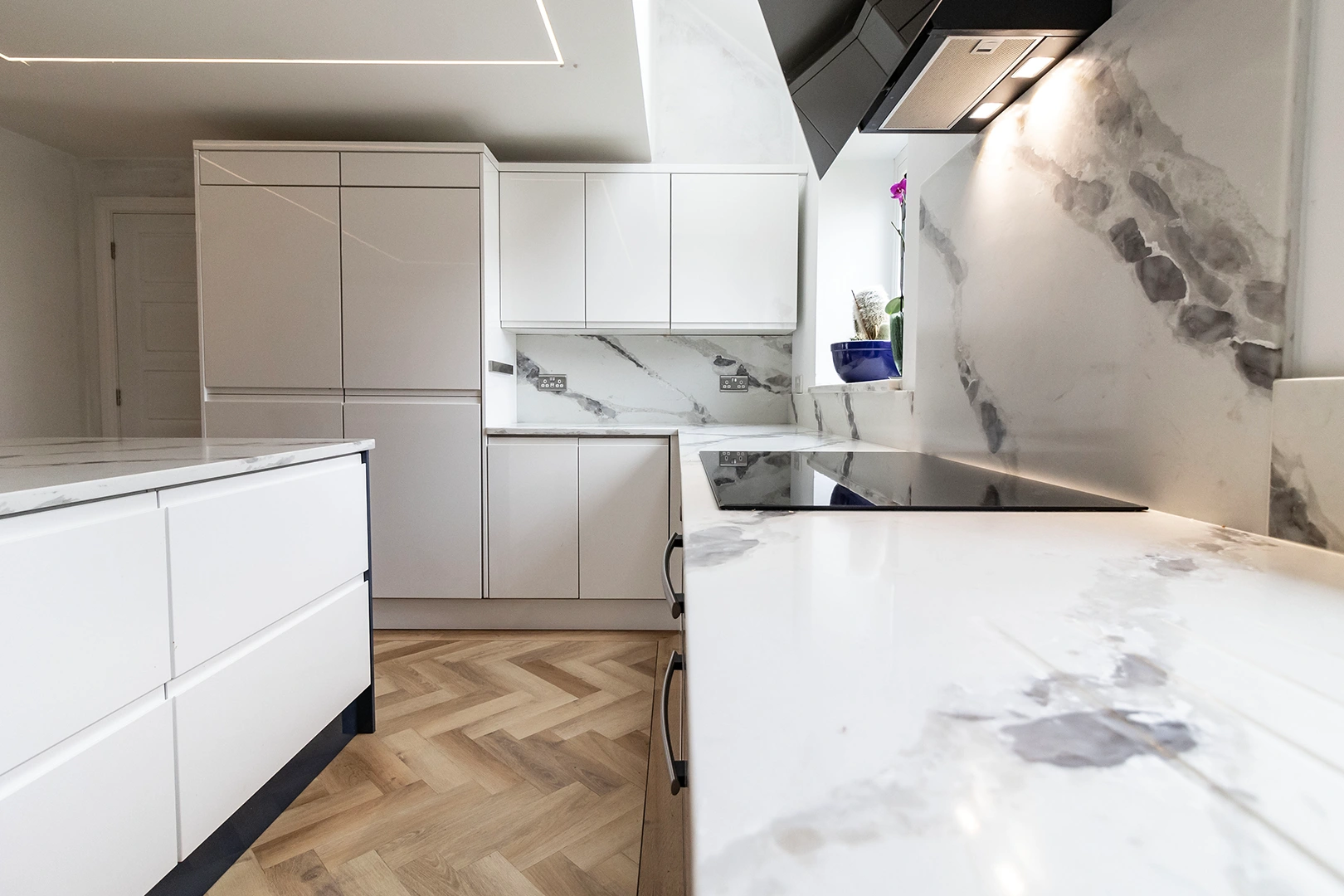
This is the most visible difference between a high-quality Calacatta quartz and a generic version. Premium Calacatta quartz uses sophisticated pigment placement and resin techniques to produce veining that has visual depth, follows realistic patterns, and reads convincingly as natural stone from any viewing distance.
Lower-quality Calacatta-style quartz tends to have flat, surface-level veining that looks printed rather than three-dimensional. The veins are often regular in spacing, repeat visibly across the slab, and lack the variation in width and intensity that makes natural marble look natural.
The honest test is to view a full slab in person rather than a sample. The difference between premium and budget Calacatta quartz is far more obvious on a large surface than on a small offcut.
The proportion and quality of the white base
Calacatta-style quartz varies enormously in the whiteness and clarity of its base colour. Premium versions use high-purity ground quartz and clean white pigments that produce a bright, optically pure white. Lesser versions use lower-grade material with grey or yellow undertones in the base, which makes the slab look dull even before the veining is considered.
This matters because the contrast between the white base and the veining is the entire visual effect. A grey-tinted white base with strong veining looks muddy. A bright white base with the same veining looks crisp and contemporary.
In direct comparison under good light, the difference is immediately obvious. In showroom lighting on a small sample, it’s much harder to see.
Resin quality and UV behaviour
Calacatta quartz uses resin to bind the quartz particles and to suspend the pigments that create the veining and the white base. The resin formulation is where some of the biggest quality differences sit, and it’s also where some of the most common failures happen.
Premium resin systems from major brands are formulated to resist UV-induced colour shift, heat tolerance to industry standards, and chemical resistance to common kitchen substances. Lower-grade resins can shift colour under prolonged sunlight (particularly in white-based products), discolour with heat exposure, or stain from common spills.
For Calacatta quartz specifically, UV stability matters enormously, because the product is overwhelmingly used in kitchens with substantial glazing, often on islands sitting in direct light. A Calacatta slab that yellows over five years against the rest of the kitchen is a visible and irreversible problem.
Premium brands publish UV ratings for individual colours. Lower-tier products often don’t, and the absence of published data is itself a useful signal.
Slab dimensions and the island question
Calacatta quartz is most often specified for kitchen islands, which tend to be larger than the runs of worktop along the perimeter. Standard quartz slab sizes vary by manufacturer, but most fall in the range of 3.0 to 3.2 metres long by 1.4 to 1.6 metres wide.
Several premium quartz manufacturers now produce large-format Calacatta slabs at dimensions up to 3.4 metres by 1.65 metres, which allows larger islands to be fabricated from a single uninterrupted slab. Lower-tier manufacturers typically only offer standard sizes, which means islands beyond the standard slab size require a join.
For Calacatta specifically, joins are more visible than they are on plainer materials. The veining doesn’t continue cleanly across the join, and book-matching across two slabs (where the patterns mirror each other) requires sourcing sequential slabs from the same production run. This is possible with premium brands and often impossible with budget options.
If your island will exceed standard slab dimensions, the choice of Calacatta brand directly affects whether you can have a single-slab island or whether you’ll need a visible join.
Brand-specific Calacatta options worth knowing
Several major quartz brands produce Calacatta-style designs with established reputations. Silestone, Caesarstone, Cambria, Compac, Vadara, and Sensa all offer Calacatta-equivalent ranges with varying styles, vein patterns, and base whiteness.
Different brands suit different aesthetic preferences. Some Calacatta designs lean toward bold, statement veining with dramatic contrast. Others lean toward soft, restrained veining that reads almost as a textured white. The “right” Calacatta depends entirely on the kitchen it’s going into and the surrounding palette.
We encourage customers to view full slabs across multiple brands before committing, because the differences between named Calacatta products from established manufacturers are substantial enough that the choice genuinely matters.
Edge profiles and how Calacatta reads in three dimensions
A subtle point that matters more than people expect: the edge profile of a Calacatta quartz worktop affects how the material reads visually. A standard 20mm or 30mm edge shows a slice of the slab pattern at the front. On a Calacatta product, this slice can read as a stripe of veining or as a flat coloured edge, depending on where the cut falls.
Mitred edges (where two pieces are bonded at 45 degrees to create the appearance of a thicker top, typically 50mm to 100mm) wrap the surface pattern around the edge, which on Calacatta produces a more refined and continuous look. The cost step up is real, but for a Calacatta installation specifically, mitred edges often justify themselves visually.
This is one of the design decisions that benefits from being made in front of a real slab rather than from a brochure.
When Calacatta quartz is worth the premium
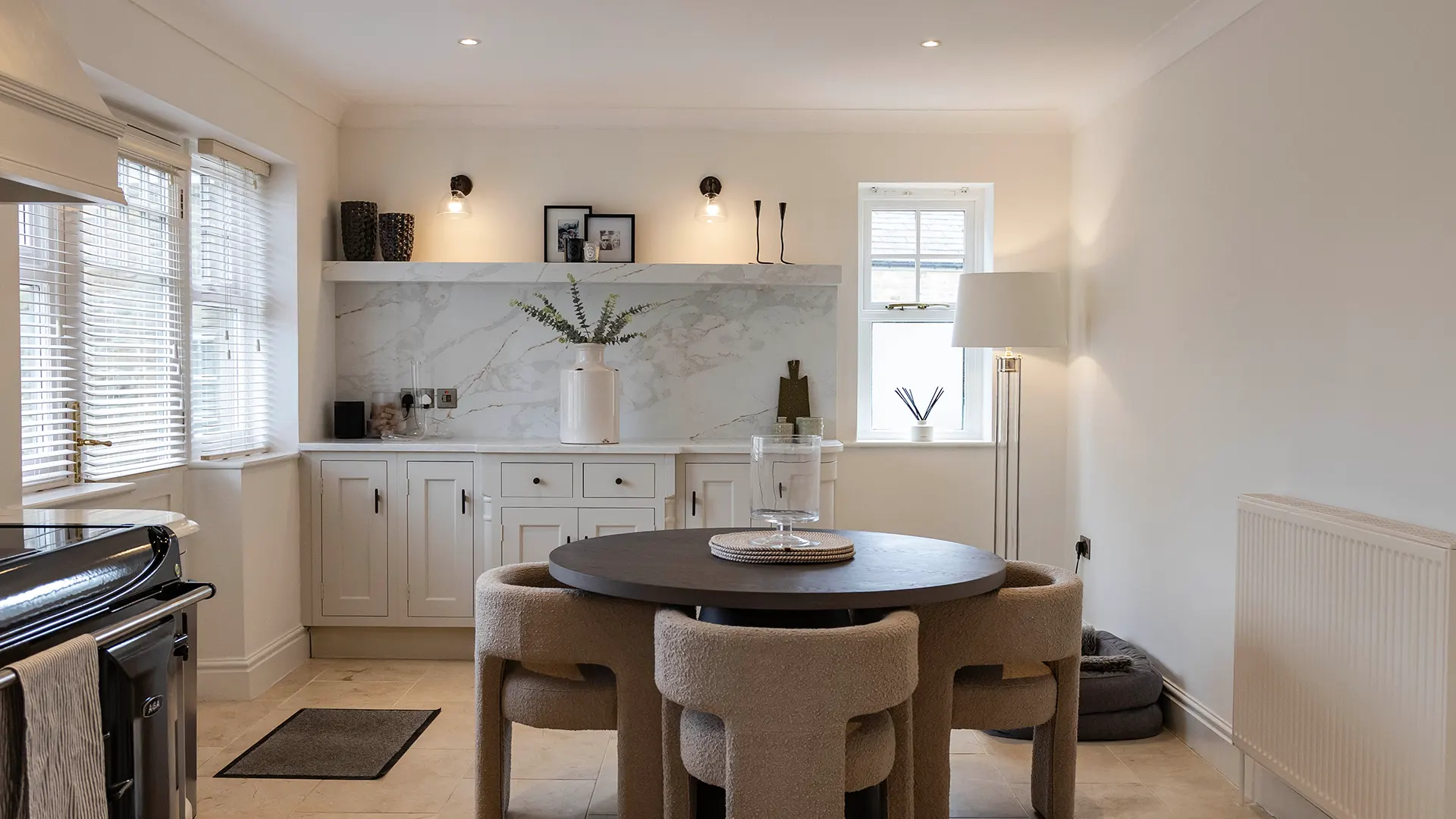
The honest answer is that Calacatta quartz makes sense when the worktop is meant to be a design feature. On a centrepiece island in an open-plan extension, with quality lighting and a contemporary kitchen design, premium Calacatta justifies its cost because the slab is doing visual work that a plainer material couldn’t do.
On a perimeter run of worktop tucked under wall cabinets in a smaller kitchen, where the worktop is mostly utilitarian, premium Calacatta is harder to justify. A solid colour quartz or a granite at a lower price point will perform identically and the visual impact of Calacatta will be lost.
The hybrid approach (premium Calacatta on the island, more budget-friendly quartz on the perimeter runs in a coordinated colour) is one we recommend regularly. It puts the cost where the visual impact is and saves on the surfaces that don’t need to make a statement.
Real scenarios from UK installations
A family in Leeds had a contemporary kitchen with a large central island and bifold doors along the rear wall. They had been quoted for a budget Calacatta-style quartz from an unbranded source. We viewed both options against the natural light in their kitchen using full slabs in our Pudsey showroom, and the difference was immediate. The premium slab held its brightness in the direct light; the budget option read as grey-tinted. They upgraded, and the island remains the design feature of the room two years on.
A property in Harrogate wanted a fully Calacatta kitchen across both island and perimeter runs. The total area pushed the budget significantly. We proposed running a premium Calacatta on the island and a coordinated white quartz with subtle veining on the perimeter runs. The visual effect from across the room reads as a fully Calacatta kitchen, and the cost saving on the perimeter material made the overall budget workable.
A York extension required a 3.3-metre island in Calacatta quartz. Most standard-format slabs would have required a join across the island. We sourced a large-format Calacatta from a manufacturer producing slabs up to 3.4 metres, fabricated the island from a single piece, and the surface reads as one continuous flow of veining.
The questions worth asking before you commit
If you’re considering Calacatta quartz, the answers to these will separate the strong specifications from the disappointing ones:
What brand is the Calacatta, and can I see the manufacturer’s published specification?
Does this specific colour have a published UV rating? Where will it sit relative to windows or bifolds?
What’s the maximum single-slab size in this product, and does that suit my island dimensions?
Can I view a full slab in person, not just a sample?
If a join is needed, can the slabs be book-matched, and what will the join look like in the finished kitchen?
What edge profile do you recommend for this material, and why?
Suppliers who answer these clearly are ones who handle premium quartz regularly. Suppliers who give vague answers are ones who treat all Calacatta as essentially the same product.
How Meridian Granite handles Calacatta quartz installations
We work with the major Calacatta quartz brands (Silestone, Caesarstone, Cambria, Compac, Vadara, Sensa, and Dekton’s marble-look range) and hold full slabs of multiple options in our Pudsey showroom. Customers can compare brands in person under natural light before committing.
Templating is laser-based, fabrication is in-house in our Pudsey workshop, and installation is carried out by our own teams. For Calacatta installations specifically, we discuss join placement, book-matching options, and edge profile choices with the customer at templating stage rather than treating them as fabrication-stage decisions. We also flag UV exposure considerations for islands sitting in direct sunlight before the order is placed.
Conclusion
Calacatta quartz can be a genuine kitchen feature when the product is right, the placement suits its strengths, and the fabrication respects the material. It can also be a disappointment when budget options are specified without understanding the differences, or when the wrong colour is placed in direct light without considering UV behaviour.
The premium is worth paying when the worktop is doing visual work in the room. The premium is harder to justify when the worktop is purely utilitarian. The hybrid approach (premium on the visible surfaces, simpler material on the rest) often produces the best value.
If you’d like to compare Calacatta quartz options from multiple brands in person, our Pudsey showroom holds full slabs and our team is happy to talk through what will work in your specific kitchen.